Last week, I wrote a post about my upper elementary Genius Hour projects. In that post I mentioned that I still had a number of presentations to watch. Now that the dust has settled and nearly all students have presented, I have a few more things to show off for you.
This fourth grade girl learned how to make exploding fish (a new recipe for me) and demonstrated at home via video.
This sixth grader would like to be a triathlete one day. so she created this Haiku Deck about how to train for a triathlon.
Here is a fifth grade girl who asked her dad to teach her how to play guitar. The result is this video.
This sixth grade boy created a stop motion video about Jesus walking on the water. I love the waves in the video!
Who will win the Rodent Race? This sixth grader pitted two family pets against each other in a maze. Find out who will win!
Here is a great stop motion video teaching us how to make an origami star.
Thanks for watching! What have you been doing with Genius Hour in your class?
As an elementary computer teacher, I see my students for about 50 minutes a week. While I love the idea of Genius Hour in my classes, I find it hard to implement a "traditional" Genius Hour model with my students, so I developed a "Genius Nugget" concept. This is the second time this year we have dedicated roughly four weeks of classes to student innovations. Read below as I interview myself about the process.
You already did these projects in the fall. Did you make any changes in the project for the winter?
Yes, I made a few changes based on the outcomes of the fall projects. I recognized that most of our projects before were fact-based and not truly innovations. So for this round, they had to learn a new skill or build something new. Likewise, I realized that far too many students created a PowerPoint and didn't try to stretch themselves with their presentations. That made me ban all PowerPoints, forcing a lot of videos. We also so a number of Haiku Decks, Educreations videos, and a couple web sites.
I also made some organizational changes, but I don't really want to talk about those.
What were those changes? It's OK to share.
Well, with 61 students doing these projects at one time, I wanted one central place to collect, assess, and return student work. Microsoft has a great tool called Teacher Dashboard that does this. I love Teacher Dashboard for most assignments. As long as the assignment doesn't need to come back to the teacher a second time, TD works like a charm. However, I quickly came to realize that this is a horrible tool for Genius Hour. I essentially wanted students to use the same document to communicate with me each week. I thought TD would help us cycle back and forth between student and me, over and over. Nope. It was a hopeless mess and wasted countless hours on my part. In the end, I was collecting work in any possible means, negating my original goal of having a super organized workflow.
In the end, this was a great way to remind my students that failure is a part of innovating. You learn from your mistakes and move on, improving all the time.
Let me add that the folks at Microsoft are wonderful. I had two separate people listen to my problems and tried to help me salvage the mess. I was really impressed with how much they were willing to help me out. Microsoft has come a long way in listening to teacher needs.
What were some of your more interesting project ideas?
I must say that "learn a new skill" was not an easy concept for some students to understand. One boy wanted to talk about how many touchdowns a particular NFL player scored, then bopped to another similar idea, and so on. I found myself saying, "What new skill will you learn?" quite often. It was hard for some students to nail down a good idea.
What I didn't want was to create a lot of work for parents. However, I had one family that learned to ski. Another (6th grade) girl decided she wanted to learn how to drive. After her driving lesson, she switched gears and went with using a green screen. We had a few cooking demonstrations. We had students teaching themselves French, Japanese, and German. Overall, it was a great experience for most of them.
How did parents react to this project?
Surprisingly, I got absolutely ZERO negative reaction to the projects this time around. Due to our technical difficulties, I had a lot of parent interaction, and everything was very positive. This is a unique project idea, and I think students and parents alike appreciate the ability to pursue something of interest to the student. It's a lot of work, but it's work the student enjoys doing... and we trick them into learning too.
And, tell me what teacher wouldn't want an email like this?
And thank you! He really enjoyed it and worked on it passionately because he had fun doing it. As he practiced his presentation last night he said he was really glad he got to do projects like this. I know it is a lot of work for you, thank you for making the investment.
What did you learn through this process?
I learned quite a bit, actually.
Obviously, I've already mentioned my Teacher Dashboard issues and learning that that OneNote Class Notebook is a better tool for this job.
I learned (or maybe re-learned) I need to be more proactive when looking over the shoulder of studying students. Some kids can work independently and come up with an amazing product. Others need more guidance, and I can't rely on them to come to me for help. I had a student who restarted his project two times before his parents had to intervene with just days left before the due date. It's easy to get swept up in the work that goes with 60+ projects, but it does me no good if I can't sit down next to a student to give him a hand.
Another issue a lot of families had was getting a video off of their phone or iPad and to me. Those files are too big to email, so we had to brainstorm some alternatives. When I'm done with this interview, I'm going to make a list of ways to transfer video from phone to teacher. I'll make this part of the standard "paperwork" I give to students at the start of a project.
I also learned how hard students can work. Once the project got rolling, I was amazed at how well the students settled in. There were no disciplinary problems, because students were into the project. I realized once again, that Genius Hour is such a great way for students to grow academically while also chasing down passions they have in their lives.
Are there any projects you would like to share with the readers?
I have quite a few of them I'd love to share. At this point, I still need to hear another 20 or so presentations, but here are the best of them so far.
This 6th grade student wanted to learn about archaeology as a potential career path and taught himself how to create a Prezi in the process.
This fourth grader explored iMovie by making a silent movie.
This fourth grade girl documented her journey learning competitive cheer this year by creating a video.
This fourth grader learned about stop motion on his iPad and used iMovie to add music. While the bulk of his video is a good anti-bullying video, I thoroughly enjoyed his dancing stickmen at the end.
This is the cutest French lesson you ever get, by a lively fourth grader.
Learn about great moments and great players in baseball history from this web site.
Here is a fifth grader who created a cardboard track in his living room and showed us how he tested in with his R/C car. Enjoy!
These three fifth grade girls worked together to learn how to make chocolate. Then, they each recorded their own videos in their own kitchens. Welcome to Food Network, ladies.
Wow! That is some great learning your kids did. Thank you for showing off their work!
Hey, you're welcome. I'm hoping to get another group of presentations ready to show off about this time next week. There are still some good things coming.
If I had to summarize the 2016 Ohio Ed Tech Convention in one word, that would be the word. It's not like every speaker and presenter said "innovation" or even thought about it as they created their sessions. But, innovation was always lurking under the surface of everything that happened.
It all started for me before I ever left my house in Kentucky. I was introduced to Parking Panda, a site that allows you to prepay for parking, giving you a guaranteed space when you arrive on the scene. This was huge to me after being forced to park at a meter for the last day of the conference last year. ("I'll be at your session next hour, as soon as I go feed the meter!" Yup! That made me look cool at a nerd convention.)
Innovation came out loud and clear as I listened to Jaime Chanter talk about her future club and how she helps four different schools learn about coding, robotics, and maker spaces in before school clubs in Lakewood School District. Innovation was the key element to Mrs. Thoma and Mrs. Frederick talk about using Genius Hour and coding in their 4th/5th combined class every Wednesday.
It was Jaime Casap telling educators to find ways to innovate how to educate so (school) learning becomes relevant for this generation of learners. It was Hadi Partovi explaining how he created code.org in an attempt to bring computer science to every school in America and raise the percentage of women and minorities involved in computer sciences.
Innovation was the theme of a group of teachers from Forest Hills School District that have incorporated blended learning in their high school instruction. Each one found different ways to blend their learning, but they all have worked hard to find what works for them and their classes.
Innovation was woven through all the sessions, even those that were not so inspiring. After all, every tech tool discussed either didn't exist five years ago, or have been significantly updated in those five years.
---------------------------------------------------------------------------------------------------------------------
I was struck by a pair of pictures that Jaime Casap put on the screen. On one side was a class of students sitting in rows, using iPads. On the other side was a black and white picture of a class sitting in rows listening to the teacher lecture. He pointed out that there isn't much difference between the two pictures. And, he's right.
What if I came into your room at a random time and took a picture at a random moment? Would that picture look any different than a picture taken 100 years ago? Sure, your kids may have iPads in their hands, but do those iPads radically change how instruction happens? Or, does the technology help you teach in all new ways?
----------------------------------------------------------------------------------------------------------------------
I walked away from OETC this year with a bit less knowledge than I would have liked but a whole lot more drive. Seeing as the 21st century is old enough for a driver's license in Ohio, I think it's time my school implements the 4Cs of 21st century learning. I'm so happy that I attended the convention with a colleague who feels like I do. We need to make a concerted to help our colleagues use technology in new ways in our school.
I think I have renewed Innovation Project for myself.
We're off with our next major video project in Media Production. The other day, our students sat down in a client meeting with our Development Department to discuss the Servathon videos we need to produce.
When I look at the above photo, it blows me away. There are three administrative team members in the room (one not pictured), two teachers (one not pictured), two staff members, and five high school freshmen (one not pictured), all taking part in the same meeting. How often does a 15 year old student get the opportunity to sit at a table with an adult (an authority figure) and be treated as an equal?
You'll also see the big screen in the background of the meeting. Our OneNote Class Notebook was on the screen as members of our team were typing up notes and referencing the client worksheet that was previously inputted. (See below.)
Client Worksheet: Completed before the meeting and added by one of our teachers.
Collaborative Workspace: Students taking notes as the meeting progressed.
Close up of our fearless leader and his shiny toy.
The next day, two of our students sat down to brainstorm ideas and put together an initial storyboard for the videos that we'll build.
Personally, I think we hit gold with our class model. These students will learn so much this semester, not just about creating quality videos, but also about being professionals and working in a small business. I'm looking forward to what we'll see out of these students!
"Innovations usually begin life with an attempt to solve a specific problem, but once they get into circulation, they end up triggering other changes that would have been extremely difficult to predict."
What do you think is the most world-shaping innovation ever? If you're like me, you probably thought of something like the Internet or mobile technology. But, we'd be thinking too narrowly. Maybe one day those things will make the cut.
In this book, Johnson looks at innovations that have totally recreated the way we live. Here are some interesting tidbits that I enjoyed.
The creation of the printing press led to a huge need for reading glasses.
Air conditioning changed presidential elections.
You can't read this blog post without glass, but the amount of ways glass plays into bringing this post to your eyes will boggle your brain.
Inventing the light bulb was only one small part of actually lighting up a city.
What does this have to do with education? I still have hopes of one day leading my own Innovation Class, and this book may well be required reading for that class. Innovation doesn't necessarily happen in a vacuum. One person's great idea can lead someone else to another great idea. I learned how glass artisans in Venice were forced to relocate to a nearby island which caused an explosion of glass innovation.
...by concentrating the glassmakers on a single island the size of a small city neighborhood, they triggered a surge of creativity, giving birth to an environment that possessed what economists call 'information spillover.'
"Information spillover" sounds exactly like what I would love to see out of the innovators in my school. By reading this book, my hopes would be that my students would see that what they create goes beyond their personal bubbles but have the potential to change the way people all around see world!
I co-teach a couple Media Production classes. These classes are offered to middle school and high school and are a semester long. This time frame seems to be a good length of time to teach the basics of video and sound production and give students a rudimentary skill set needed for recreational and (maybe) professional and volunteer media production.
But what happens when a group of students takes the class for a second semester?
We have that problem this semester, as our five high school students are last semester's four plus a friend. These students have the skills they need to create great videos, but they need practice to improve those skills.
Our Development Department wants videos made for our upcoming Servathon. Our Admissions Department wants videos made for our upcoming Open House. We anticipate more video requests as the semester rolls on. These videos need to be professional and serious, unlike videos they may have produced in the past. This requires a different focus than we had the first semester.
Two days into the new semester, we set up a faux business model, calling our students employees and we are the supervisors. But we wanted a digital tool to tie it all together.
We have five students all working on completely different projects, filming, editing, teaching, and learning. It's easy for someone to lose track of what he is supposed to do each day. Likewise, it's not hard for the over-achiever to get slammed with work while the YouTube wonder sits back and watches videos for four days straight. OneNote removes that problem. Every Monday we will start class with a staff meeting, assigning jobs for each day of the week and posting them in OneNote. This is especially helpful on those days when one of the co-teachers can't make it to class. We can all access the same information in the same place.
We have places set up for storyboards to reside and places for the guys to take notes about the mistakes they made and the ideas they have for future projects. We have collaborative space where great ideas can bloom and individual work spaces where students can jot their private ideas.
Creative team meetings can happen on our Aquos touch screen, with storyboarding drawn directly into the notebook. At the same time, students can type daily updates so "supervisors" and "employees" can have a running journal of how a project was put together.
We even have a page for "employee reviews" (aka rubric) so students know exactly what is expected of them.
I'm looking forward to seeing how this semester turns out as we use this great teaching tool to guide our video productions.
A high school student asked, "Mr. Dunlap, what J-Term class are you teaching this year?"
Me: "Orphan care."
Him: "Oh..."
I got a chuckle out of that conversation. I explained to the student that I have two main passions, and this year I wanted to focus on the other passion. As a technology teacher, the expectation would be that my J-Term class would focus on technology in some way. Most of my students know that I'm an adoptive dad, and it just makes perfect sense that I care deeply about caring for the fatherless.
We hold J-Term for our middle and high school students during the first week back from Christmas Break. Classes are roughly 2 1/2 hours long each and have nothing to do with the regular curriculum.
One of my colleagues, Jessica Finney, and I teamed up to teach the class. I was a bit disappointed that our class had only four students, but I can honestly say that they were the right four students. By selecting our class, they had to give up the chance to decorate cakes, survive in the wilderness, crochet, take care of cats in a shelter, and do a host of other fun classes. Obviously, they had a reason to want to learn about serving the fatherless before they walked into class on Monday.
Show Hope has a great student club, called The Movement, which provides materials necessary to launch high schoolers into action. The goal was to use this curriculum heavily to help us through the week. However, something strange happened when we got students in front of us.... They connected better with personal stories. They soaked in the stories we told and kept asking more and more questions. They wanted to watch more videos about adoption and foster care. In short, they couldn't get enough stories.
To quote Chris Wheeler from Show Hope, the intent is to move students "from unaware to aware to action."
The "unaware to aware" part was easy. We just put on a parade of guest speakers to talk about how adoption has affected their lives. I'll list the guest speakers below, but we hit a broad range of topics just by talking about personal experiences. Domestic and international adoption and foster care were certainly part of our discussions. However, we talked about why there is an orphan crisis to begin with -- unwanted pregnancies, abusive parents, and poverty to name a few. We talked quite a bit about the costs of adoption and ways to fund adoptions. We showed videos and looked at blogs and Instagram posts. We invited speakers in via Skype. We also talked about Compassion International which is an organization that helps to end poverty in third world counties. By sponsoring a child, you provide them with food and education to help them make a difference in their country. If you look hard enough, there are examples all around of the orphan crisis and how someone can stand up for orphans. And that doesn't always mean adoption. There are tons of ways to help someone in need.
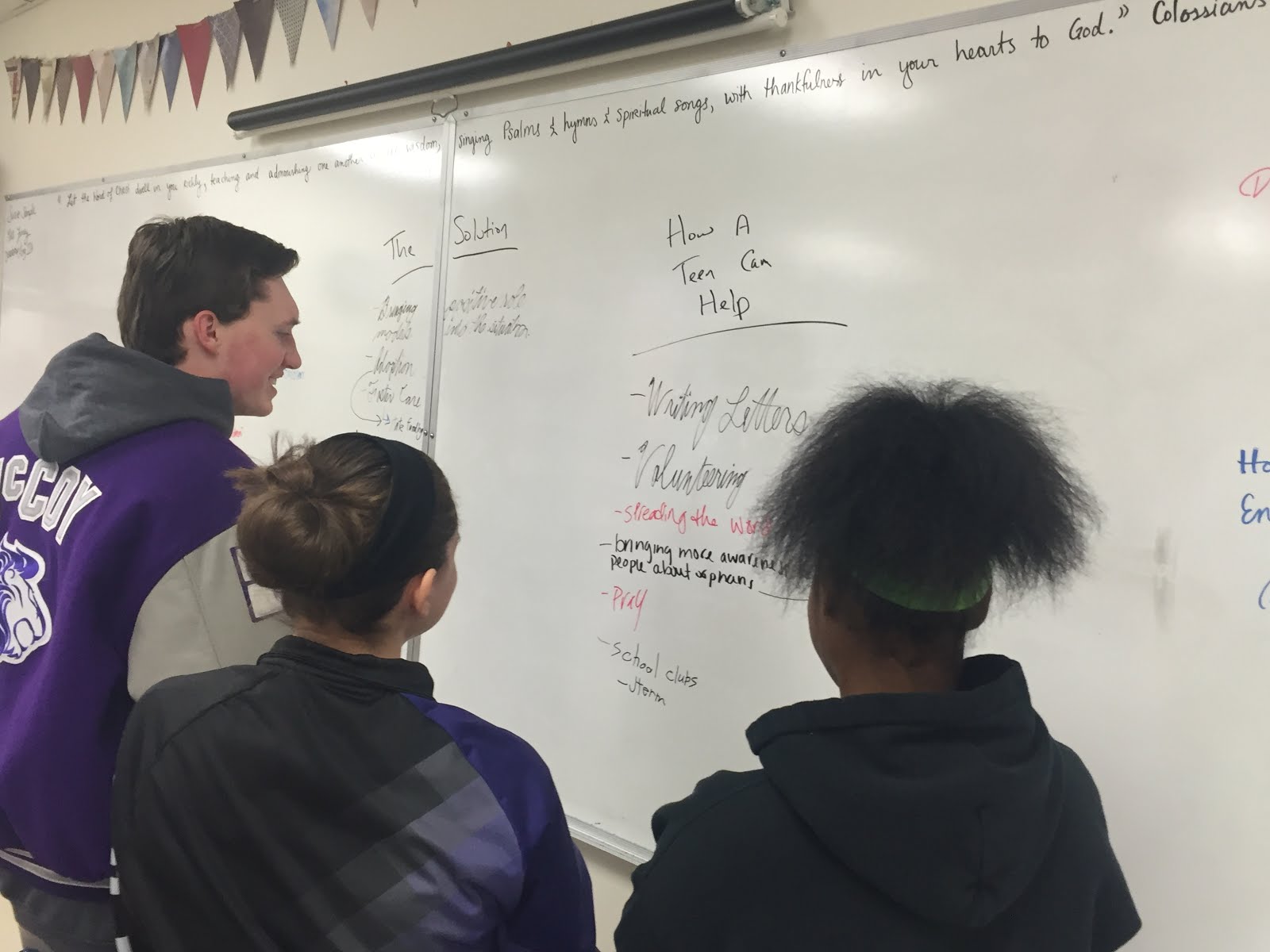
To be honest, I am stunned how much we covered in a short time. On Wednesday, we put three columns on the board (The Problem, The Solution, How a Teen Can Help) and asked them to fill the columns with their ideas. In my opinion this was a watershed moment for the class. We took all our thoughts swirling in our heads and got them written down in front of our faces.
In the second half of the week, we got more personal by talking to the students' peers. We had a total of four visitors, three girls who have been adopted and a fourth whose two sisters were adopted out of foster care. All four stories were incredibly different, but it helped our students see how adoption can even influence people they know well.
The second part of the plan was to move from "aware to action." That was a bit tougher. First, it's not right to assume a student wants to be part of the solution. Second, the students need to take ownership of the action. I could certainly push them to do some things but for it to be meaningful the ideas really had to be their own.
It was so encouraging to hear them talk about wanting to be adoptive parents or siblings. At least two of them are contemplating taking missions trips to China. We've talked about starting a club next year and about how a college student can be an advocate for orphans. I wouldn't be surprised if this summer finds a volleyball camp at our school for foster kids and it won't be long before awareness posters are up in the hallways at school.
Sadly we ran out of time before we put together a solid action plan for the future, but I'm just excited to see teens with a desire to help those in need.
Now, to my thank you section...
Jessica Finney -- teacher at MVCA and future foster/adoptive mom. When I say "we," many times I mean "she." Jessica has broad knowledge of anything dealing with foster care, adoption, and helping those in poverty.